
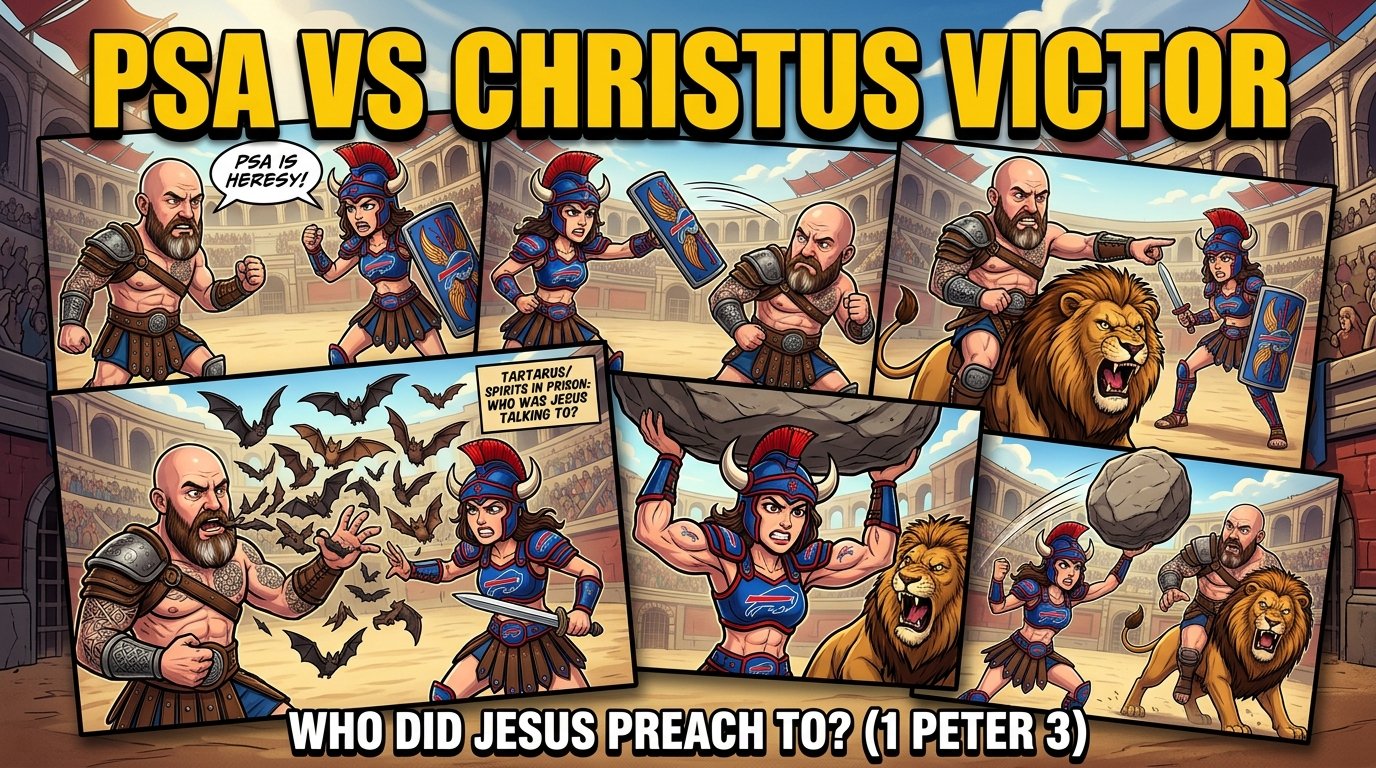
A gladiator-style showdown captures the episode's clash over penal substitutionary atonement, Christus Victor, and the spirits in prison.
PSA vs Christus Victor & Who Did Jesus Preach To in 1 Peter 3? (Spirits in Prison)
What do a TikTok pile-on, a toddler’s stolen toy, and a two-thousand-year-old sermon to spirits in a prison have in common? All three show up in this episode, where Nate, Steph, and Michael spend the better part of two hours on two of the thorniest questions in Christian theology: what really happened on the cross, and where exactly Jesus went between his death and resurrection. The conversation starts as a reaction to a wave of anti-Calvinist creators online branding penal substitutionary atonement as heresy, and it turns into a full theological excavation of Old Testament sacrifice, the meaning of the word “atonement,” and whether God’s wrath is the same thing as the natural consequence of sin. From there, the panel pivots to 1 Peter 3:18-20 and spends nearly forty-five minutes trying to figure out who Jesus was actually talking to in the “spirits in prison.” Here’s how it all shook out.
Penal Substitutionary Atonement vs Christus Victor: The Biblical Bottom Line
Nate opens by recapping a fight that had already eaten up half his morning: a rising crowd of non-Calvinist Christians on TikTok and Clubhouse calling penal substitutionary atonement heretical, “not the gospel,” and even “cosmic child abuse.” Steph, arriving fresh, cuts straight to the actual dividing line. She states plainly that one hundred percent of Christians hold to substitutionary atonement in some form — if you deny that Christ died in your place for your sin, she argues, you are outside the faith entirely, pointing to moral influence theory (the idea that Jesus died simply as a good example, with no substitution involved) as the real heresy. The disagreement, she explains, is not over substitution itself but over the “penal” part: the claim that the first person of the Trinity punished the second person of the Trinity to satisfy divine wrath.
From there the group works through the Old Testament sacrificial system verse by verse — the woman purified after childbirth, the man made unclean by touching a corpse — arguing that these rituals were about restoring purity and covenant closeness with God, not punishment for sin. Nate pushes back with a stack of Old Testament passages and the wages-of-sin-is-death language from Romans, insisting that a real penalty for real sin is still baked into the sacrificial system even if the word “punishment” makes people uncomfortable. Nate lands the group on a working peace: Christus Victor, the idea of Christ’s triumph over death, hell, and the grave, is true and glorious, but it culminates in and depends on the substitution of Christ for sinners rather than replacing it. As Romans 3:25-26 (ESV) puts it, God put Christ forward as a propitiation so that he might be both just and the justifier of the one who has faith in Jesus — a verse that keeps both the “God is righteous and must judge sin” strand and the “Christ has won the victory” strand in the same frame. For a deeper walk through the essentials of what Christians actually believe about the cross, check out our Christian Catechism for Adults, and browse more doctrine breakdowns in our Theology Unpacked category.
Who Are the Spirits in Prison? 1 Peter 3 Explained
The second half of the episode tackles 1 Peter 3:18-20, the passage that says Christ, “being put to death in the flesh but made alive in the spirit,” went and “proclaimed to the spirits in prison, because they formerly did not obey, when God’s patience waited in the days of Noah.” Nate opens the question bluntly: was Jesus offering these spirits a second chance at salvation, or was this a victory lap announcing that the fight is already over? The panel initially confuses the passage with 2 Peter 2:4 and Jude 6, both of which describe fallen angels chained in gloomy darkness or Tartarus, before landing back on the actual text in 1 Peter 3.
The strongest argument in the episode hinges on the Greek word behind “preached” or “proclaimed” — kerysso, meaning to herald or announce, as opposed to euangelizo, the word Peter uses elsewhere in the same letter (including 4:6) for preaching the gospel. The panel notes that biblical scholarship leans heavily toward reading kerysso here as an authoritative proclamation of triumph rather than an evangelistic appeal, which rules out any “second chance after death” theory. That leaves two live options on the table: either the “spirits” are the disobedient fallen angels of Genesis 6, the “sons of God” tied to the Nephilim and imprisoned for their role in corrupting humanity before the flood, or, following the view held by Calvin and many Reformers, Christ’s Spirit was preaching through Noah himself, making Noah the “herald of righteousness” (2 Peter 2:5) and the spirits in prison simply the disobedient people of Noah’s generation who are now judged. Either way, the group agrees the passage is not describing Old Testament saints like Abraham, Isaac, or Moses getting pulled out of Sheol, since 1 Peter 4:6 already covers the dead who heard and believed the gospel while still alive. For a plain-language breakdown of the competing views, GotQuestions.org has a helpful explainer on the spirits in prison worth reading alongside the episode.
When a Toddler Interrupts Systematic Theology
In the middle of the most heated stretch of the atonement debate, Steph’s toddler wanders in demanding attention, and the discussion of divine justice briefly collapses into a parenting illustration. Someone asks the room whether a mother should punish a child for stealing a sibling’s toy and give the toy back, and the toddler, apparently consulted directly, is informed that yes, that is basically what God did to Jesus on the cross. It is, without question, the strangest object lesson penal substitutionary atonement has ever received, and Nate barely misses a beat before returning to Romans.

Wrestling with hard doctrines like the atonement? Nate’s book gives you clear, biblical footing for the tough theological questions.
Watch the Full Episode
Connect With Us
Share this post on:
 Share on Gab
.svg) Share on Truth Social
Share on Truth Social