
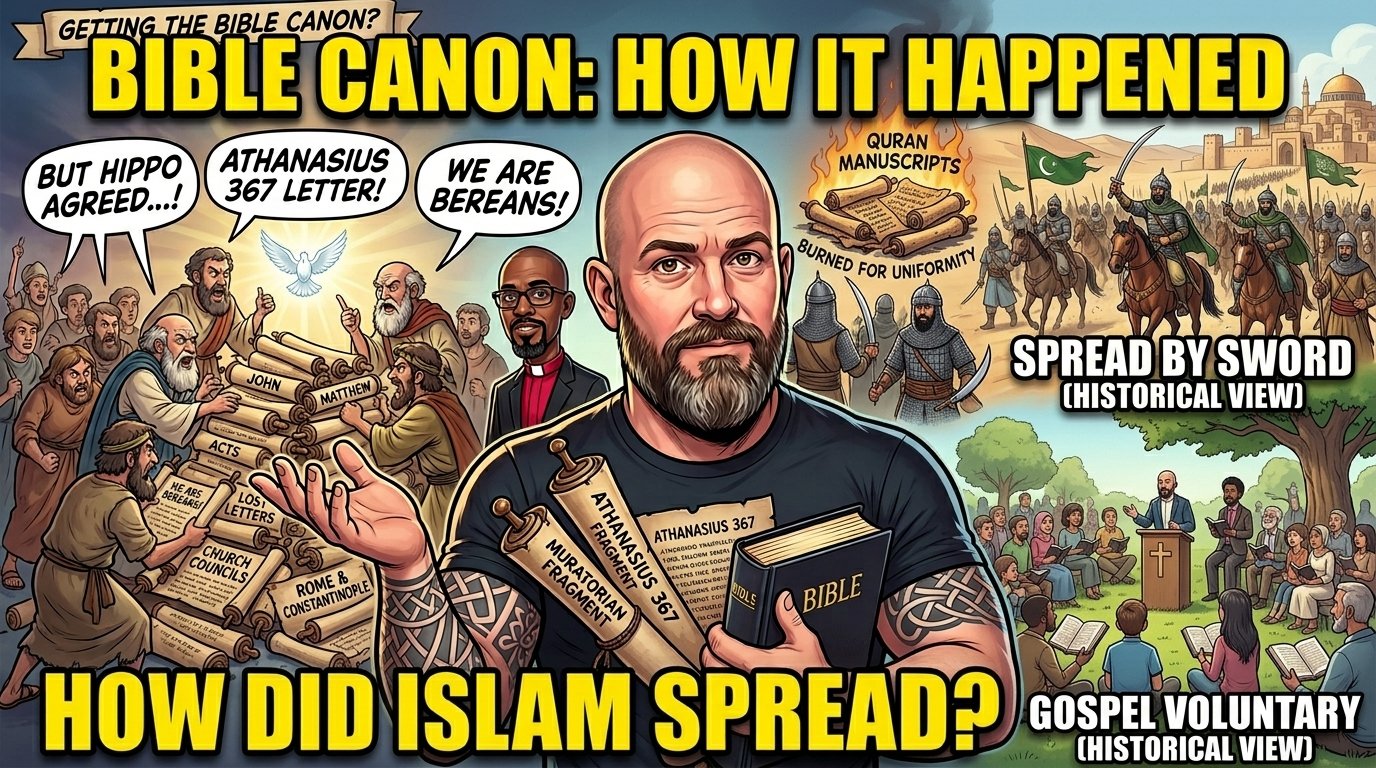
Nate holds a Bible surrounded by canon-history scrolls, contrasted with burning Quran manuscripts and armed conquest imagery on the right.
How the New Testament Canon Formed & Islam’s Child Marriage Truth
What do fourth-century church councils and twenty-first century child brides have in common on one podcast? Nothing, except that Nate and the panel covered both. The main event was the New Testament canon: how 27 books went from scattered first-century letters to a settled collection, and why that story belongs to no single denomination. Along the way, guest voices from four different Pentecostal traditions weighed in, and the conversation swung hard into Islam’s history of forced conversion and its treatment of women. Here’s what unfolded.
New Testament Canon: The Biblical Bottom Line
The New Testament canon was not handed down by a pope or a patriarch. Nate walked through the timeline: the Muratorian Fragment already listing most of the 27 books by roughly 150 AD, wide agreement building for another two centuries, and Athanasius formalizing that list in his 367 AD Easter letter. Councils at Hippo and Carthage later ratified what churches from Corinth to Ephesus had already been reading. The Apocrypha, added by Rome centuries afterward, was labeled a second canon rather than a revision of the first. Books like the Gospel of Judas and the Shepherd of Hermas were weighed and set aside, not because a committee overruled Scripture, but because, as Nate put it, the Holy Spirit leads every believer into truth, not just bishops. For the full doctrinal framing behind that claim, see our statement of faith, which lays out how Scripture’s authority stands on its own.
The conversation then turned to how the gospel actually spread versus how Islam spread. The New Testament model is voluntary: preach the message, and if a household rejects it, shake the dust off and move on, leaving judgment to God. Islam’s early expansion, historically, ran through military conquest and the imposition of tribute or death on those who would not convert. GotQuestions.org has a helpful breakdown of the canon question for anyone wanting to dig further, and the theme fits naturally under our Christian Controversies category if you want more on how faiths compare historically.
The Beekeeper Costume Sting
Somewhere between Athanasius and Aisha, Nate brought up James O’Keefe and Cam Higby’s Minneapolis stunt: O’Keefe in a fake Muslim accent, Higby fully covered in a niqab pretending to be his “wife,” testing Minnesota’s voter vouching law. One man vouched for eight strangers with zero ID required, and most poll workers waved it through without blinking. Nate’s summary of the whole thing landed somewhere between horrified and delighted, which is about the right reaction to watching election security get tested by a guy in a beekeeper costume.

Get grounded on where the Bible came from and how to defend it—Nate’s book equips you for exactly these conversations.
Watch the Full Episode
Connect With Us
Share this post on:
 Share on Gab
.svg) Share on Truth Social
Share on Truth Social