
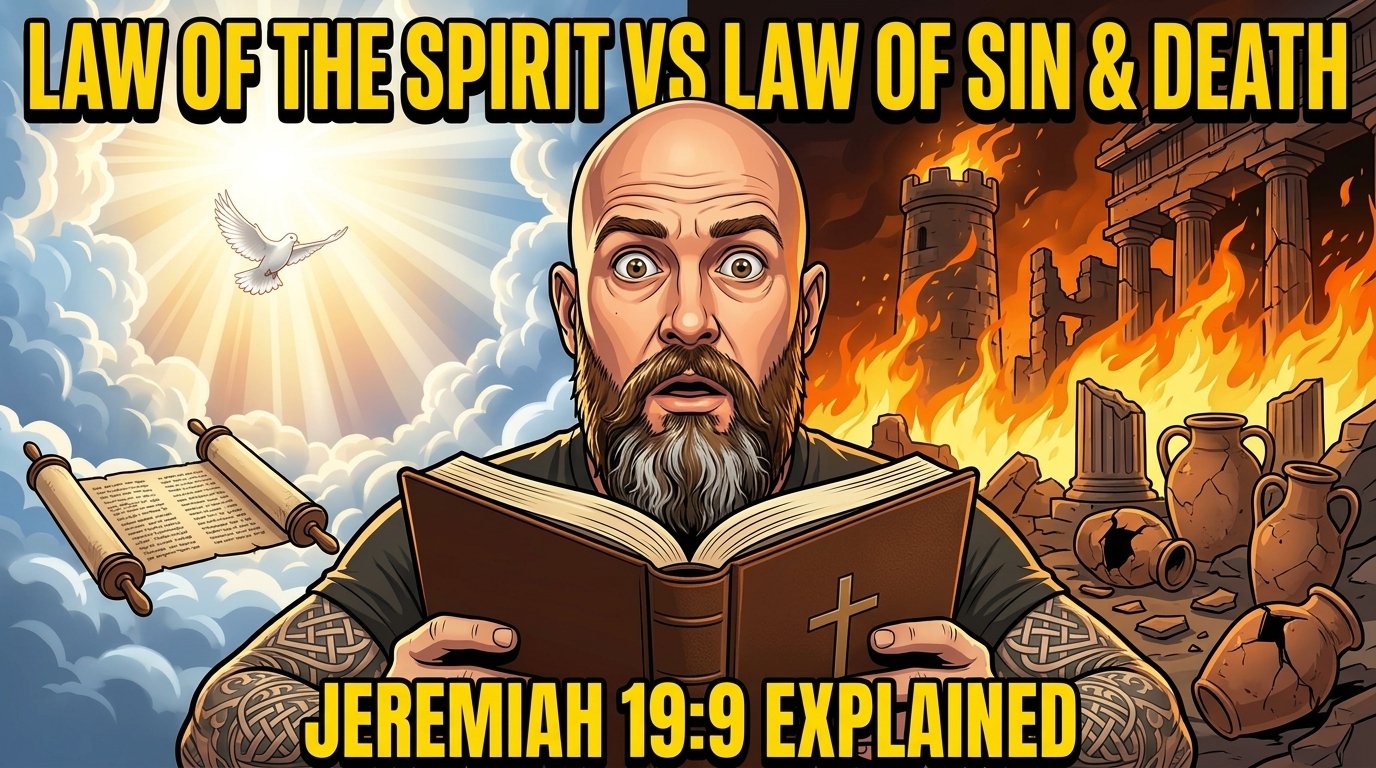
Nate holds an open Bible as a dove flies above and shattered pottery burns below—the two paths of law and Spirit.
Law of Moses vs. Law of the Spirit? Jeremiah 19:9 & Eating Children Explained
What do you get when a TikTok live gets hijacked by a Unitarian, a Jeremiah 19:9 skeptic, and a guy asking why farmers can’t eat their own fruit? For Nate, it was just another Monday. The Ask A Christian podcast opened with a grim news item—a Catholic priest in Ecuador killed when a giant crucifix detached from the wall during Mass—before pivoting into a marathon of theological troubleshooting. Between the law of Moses vs. law of the Spirit debates and a steady stream of “gotcha” verses, Nate spent the better part of an hour explaining why Christians are not under the 613 commands given to Israel, and why that distinction changes everything about how we read the Old Testament.
Law of Moses vs. Law of the Spirit: The Biblical Bottom Line
The core question came early: are Christians obligated to keep the Law of Moses? Nate’s answer was unambiguous. The 613 commandments were given to Israel at Sinai, not to Gentiles, and Christ fulfilled them perfectly on the cross. When Jesus said “It is finished,” the old covenant was completed, not abolished but fulfilled. Romans 8:2 declares that “the law of the Spirit of life in Christ Jesus has set you free from the law of sin and death”. The Law was never a ladder to salvation—it was a mirror showing humanity its sin and its need for a perfect sacrifice. James 2:10 confirms that whoever breaks one command is guilty of all, which is precisely why no one can be saved by law-keeping. For those who want a structured walkthrough of these doctrines, our Christian catechism for adults lays out the biblical foundations clearly. And for related theological deep dives, explore our Theology Unpacked category.
The Verse They Always Quote (Half of It, Anyway)
Someone dropped Jeremiah 19:9 into the chat—the one about parents eating their children during a siege—as if it were a mic-drop. Nate’s response was to simply read the preceding eight verses. Context revealed idolatry, child sacrifice to Baal, and the shedding of innocent blood. The judgment was covenant curse fulfillment, exactly as Deuteronomy 28 warned. Then the kicker: the guy who asked “did God lack forgiveness?” got a lesson on the Trinity, and the guy demanding a medal for knowing Bible trivia got compared to the Pharisees. Nate’s verdict on the “I read the Bible better than you” crowd: “You won a Bible quiz, but you’re still at war with God.”

Answer the skeptics with Scripture—Nate’s book gives you clarity for the conversations that matter.
Watch the Full Episode
Connect With Us
Share this post on:
 Share on Gab
 Share on Truth Social