
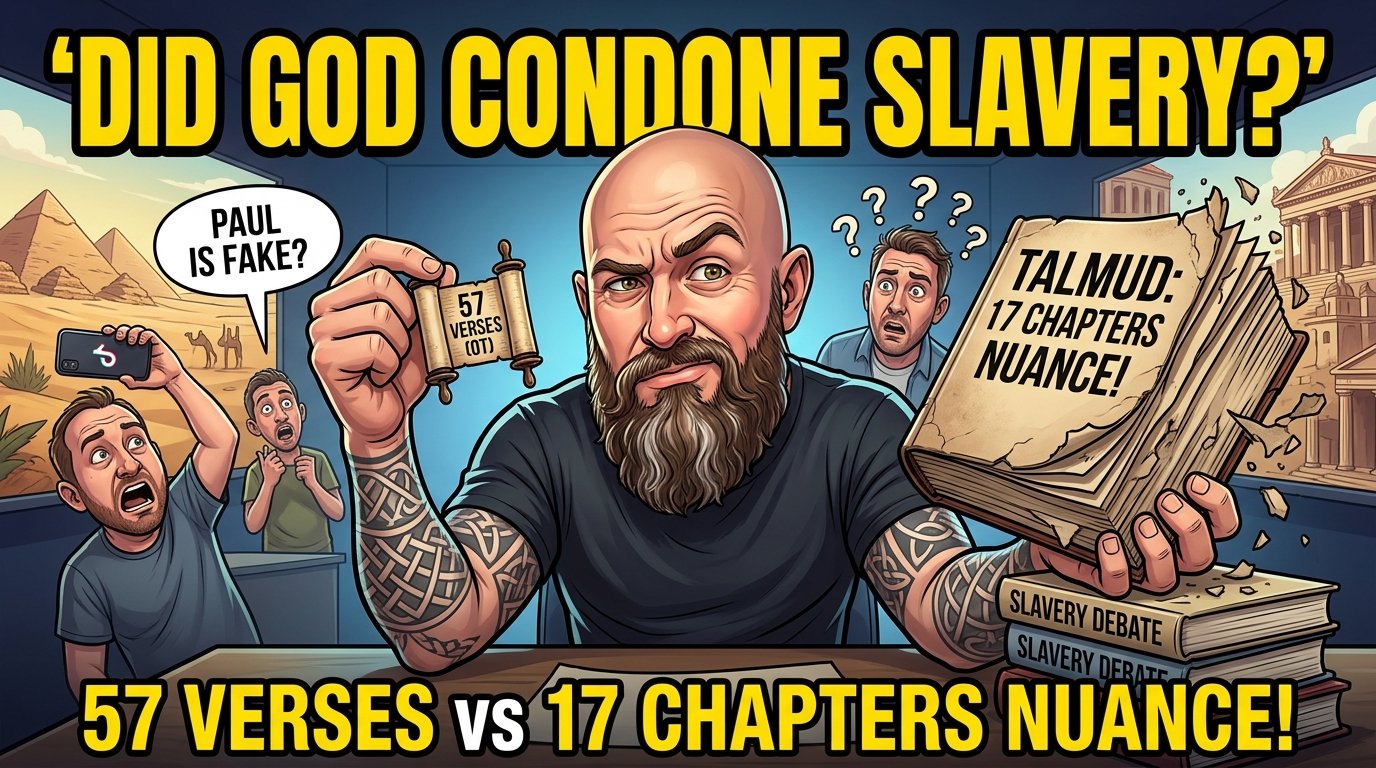
Cartoon illustration of Nate holding 57 verses beside a massive Talmud labeled 17 chapters while debating biblical slavery.
Does the Bible Condone Slavery? 57 Verses vs 17 Chapters
What happens when someone brings up does the Bible condone slavery and expects the answer to fit neatly into a few isolated verses? Nate spends a substantial portion of this episode arguing that context matters—especially when discussing the Law of Moses, ancient Israel, and the way those laws were actually interpreted by the people who received them. The conversation eventually gets very specific: roughly 57 biblical verses dealing with slavery and servitude are compared with 17 lengthy Talmudic sections explaining how those laws were understood and applied. And just when the slavery debate seems sufficiently complicated, the discussion moves into abortion, where “pro-life” and “abolitionist” turn out to mean rather different approaches to ending abortion.
Does the Bible Condone Slavery? The Biblical Bottom Line
Nate’s position is not that the Bible commands people to own slaves. His argument is that does the Bible condone slavery must be answered by distinguishing between what Scripture prescribes, what it regulates, and what it records within a particular covenant and historical setting. The Mosaic Law was given specifically to Israel, and Nate emphasizes that Christians are not under the Law of Moses following Christ’s fulfillment of it. That matters when critics treat regulations given to ancient Israel as though they were universal commands for Christians today.
The discussion also digs into Exodus 21 and the difficult passages concerning servants, physical injury, freedom, and ownership. Nate repeatedly argues that isolated verses are not enough to reconstruct how the ancient Israelites understood their own laws. For additional biblical grounding, readers can explore our Statement of Faith and review the relevant passages in Exodus 21:26–27 in the ESV.
The episode’s central challenge is straightforward: before declaring God immoral, understand the law, its historical context, and the tradition that interpreted it. Nate points to the Talmudic material as evidence that the handful of verses commonly quoted in modern debates were surrounded by extensive legal discussion.
From “Head Cannon” to 17 Chapters of Talmud
The slavery debate produces one of the episode’s more memorable moments when the phrase “head cannon” gets thrown at Nate’s appeal to the Holy Spirit’s guidance. Nate immediately admits that the phrase is both awful and funny enough to steal. From there, the conversation escalates into a crash course in Talmudic tractates, including Kiddushin and Bava Kamma. Nate’s basic point is that if someone wants to understand does the Bible condone slavery historically, they should at least investigate how the people governed by those laws interpreted them.
That same insistence on context carries into the episode’s later discussion of abortion. Nate explains why he identifies more closely with abolitionism than traditional incremental pro-life politics: if abortion unjustly kills an innocent human being, his preference is to make that killing illegal rather than merely regulate how or when it happens. The conversation also explores the difficult question of miscarriage and why Nate is reluctant to assign criminal culpability without evidence of intentional wrongdoing.
Whether you agree with Nate’s conclusions or not, does the Bible condone slavery is not treated as a question that can be settled by throwing three verses at each other. For more help navigating difficult disagreements without abandoning biblical conviction, see Graceful Disagreement: How to Share Truth with Love.

Equip yourself for difficult conversations—Nate’s book offers biblical answers when the questions get complicated.
Watch the Full Episode
Connect With Us
Share this post on:
 Share on Gab
.svg) Share on Truth Social
Share on Truth Social