
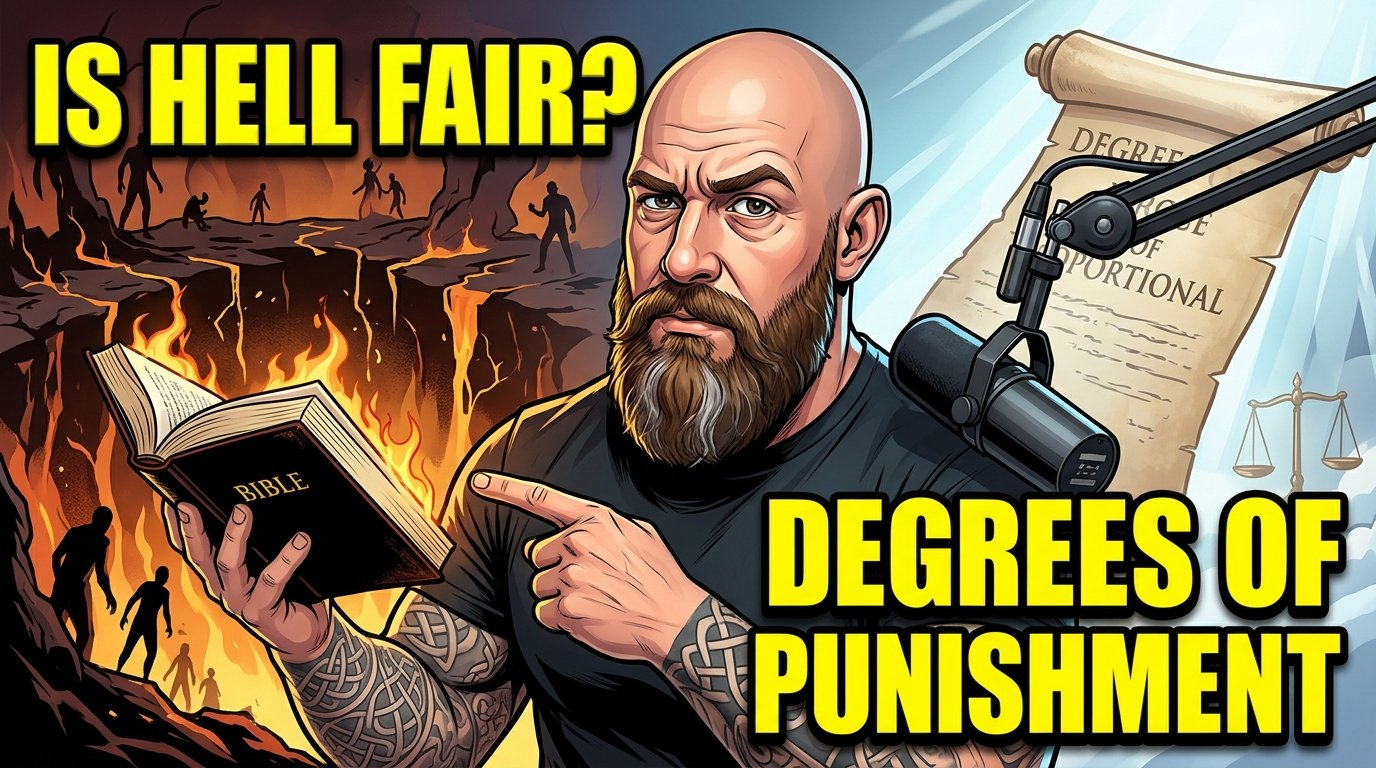
Nate tackles the tough question of divine justice and varying degrees of punishment in hell.
Is Hell Fair? Will Some Be Punished More Severely Than Others?
What happens when a caller puts God’s justice on trial? In this episode of the Ask A Christian Podcast, Nate fields a pointed challenge: If a “good” unbeliever and a wicked unbeliever both end up in the same hell, how can God be just? It is a question that trips up many, but the biblical answer is more nuanced than a simple “yes” or “no.” Nate dives into the text to unpack the doctrine of degrees of punishment in hell, showing that Scripture does not teach a one-size-fits-all eternity for the lost. Instead, it reveals a God whose justice is perfectly proportional, weighing the knowledge and rebellion of each sinner.
Degrees of Punishment in Hell: The Biblical Bottom Line
Is there truly biblical evidence for varying levels of suffering in the afterlife? Nate turns directly to the words of Jesus to make the case. He cites Luke 12:47-48, where Christ distinguishes between a servant who knowingly disobeys and receives “many blows,” and one who acts ignorantly and receives “few blows.” This establishes a principle of proportional accountability. Furthermore, Jesus explicitly declares that it will be “more tolerable” for Tyre and Sidon on the day of judgment than for the cities that witnessed His miracles (Matthew 11:22). The author of Hebrews echoes this, warning that those who trample the Son of God will face a “more severe punishment” (Hebrews 10:29).
As The Gospel Coalition notes, this doctrine does not mean hell will be “easy” for anyone. All who are there will experience weeping and gnashing of teeth. However, the degrees of punishment in hell demonstrate that God’s justice is meticulous, not arbitrary. For a deeper understanding of the core doctrines behind this justice, explore our Statement of Faith. Nate also addresses the caller’s underlying assumption about “good” people, reminding listeners that Scripture defines all as spiritually dead apart from Christ, making good works as “filthy rags” when it comes to salvation.
The Case of the Interrupted Caller and the “Filthy Rags”
The conversation reaches a boiling point when the caller interrupts Nate mid-explanation, seemingly frustrated by the biblical evidence being presented. Nate, ever the gracious host, pushes back with a simple challenge: “Go read the verses I cited and let me know what you think.” It is a classic live-stream moment where theological debate meets real-time impatience. The tension is broken slightly later when Nate, after explaining that our best moral deeds are like “filthy rags” to a holy God, clarifies that the original Hebrew term actually means something far more gross than just dirty laundry. It is a vivid reminder that our human standards of “goodness” are not the standard by which a holy God judges.

Equip yourself to answer the tough questions about God’s justice and the gospel with clarity.
Watch the Full Episode
Connect With Us
Share this post on:
 Share on Gab
 Share on Truth Social