
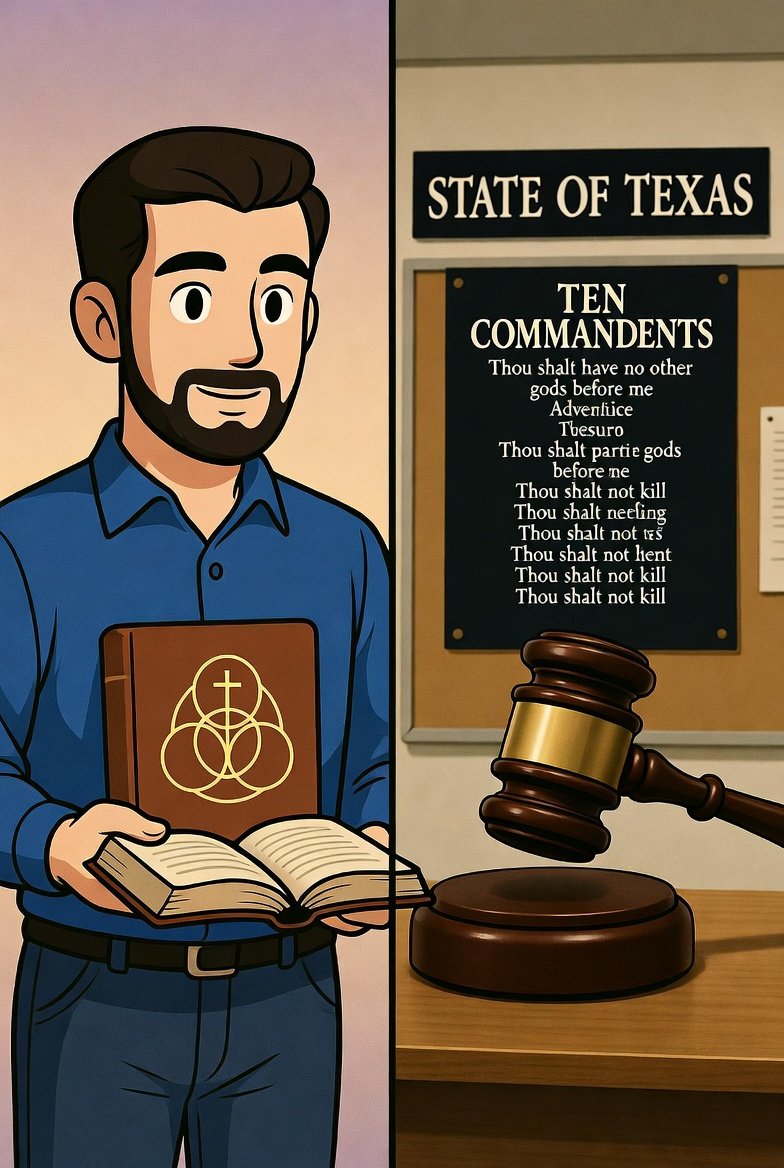
Nate tackles the Father-Son distinction and Texas Ten Commandments lawsuit with biblical precision
Is Jesus the Father? Trinity vs Oneness & Ten Commandments Removed
What happens when a federal judge orders Texas schools to remove the Ten Commandments, a lengthy Second Amendment debate ensues, and someone insists Jesus is the Father? In this episode of Ask A Christian, host Nate tackles constitutional overreach, the limits of the right to bear arms, and the most crucial theological debate of the hour: the Trinity vs Oneness Debate. Nate unpacks whether Jesus is the Father or the Son, addressing a guest who rejects Trinitarian doctrine in favor of Modalism. According to recent ACLU reports, federal courts continue blocking Ten Commandments displays in public schools, raising questions about religious freedom and separation of church and state. Nate offers his unapologetic take on both controversies while defending orthodox Christianity against theological confusion.
Trinity vs Oneness Debate: The Biblical Bottom Line
The question of whether Jesus is the Father or the Son represents the dividing line between Trinitarian Christianity and Oneness theology, also known as Modalism. Trinitarian doctrine teaches that there is one God who eternally exists as three distinct Persons: the Father, Son, and Holy Spirit, who are co-equal and co-eternal while sharing the same divine essence. Modalism incorrectly teaches that God is one Person who simply reveals Himself in three different modes or names. Scripture consistently refutes this view. The Father is not the Son, the Son is not the Holy Spirit, and the Holy Spirit is not the Father—they are different Persons, not three different ways of looking at God.
For example, John 5:22 states that the Father judges no one but has given all judgment to the Son, clearly distinguishing between the two. Jesus prayed to the Father throughout His earthly ministry, demonstrating their distinct personhood. The Bible presents God as one in essence yet three in person—Father, Son, and Holy Spirit. For related discussions on core Christian doctrine, explore our Theology Unpacked category.
When Nate Voluntarily Surrenders His Right to Enriched Uranium
After exhausting the constitutional arguments surrounding Texas schools and the Ten Commandments, Nate pivoted to the Second Amendment with characteristic deadpan delivery. The conversation meandered through California gun restrictions, class three weapons in Nevada, and whether citizens should own anti-aircraft weaponry. By the end, Nate magnanimously conceded one restriction he would accept: enriched uranium. In a moment of mock generosity, he announced he would voluntarily surrender his God-given Second Amendment right to possess weapons-grade nuclear material. The bar for reasonable gun control, apparently, begins somewhere between rocket launchers and radioactive isotopes from warlords in Chad. Constitutional originalists everywhere breathed a sigh of relief.

Master the Trinity and other tough questions—Nate’s book equips you to defend biblical truth with confidence.
Watch the Full Episode
Connect With Us
Share this post on:
 Share on Gab
.svg) Share on Truth Social
Share on Truth Social