
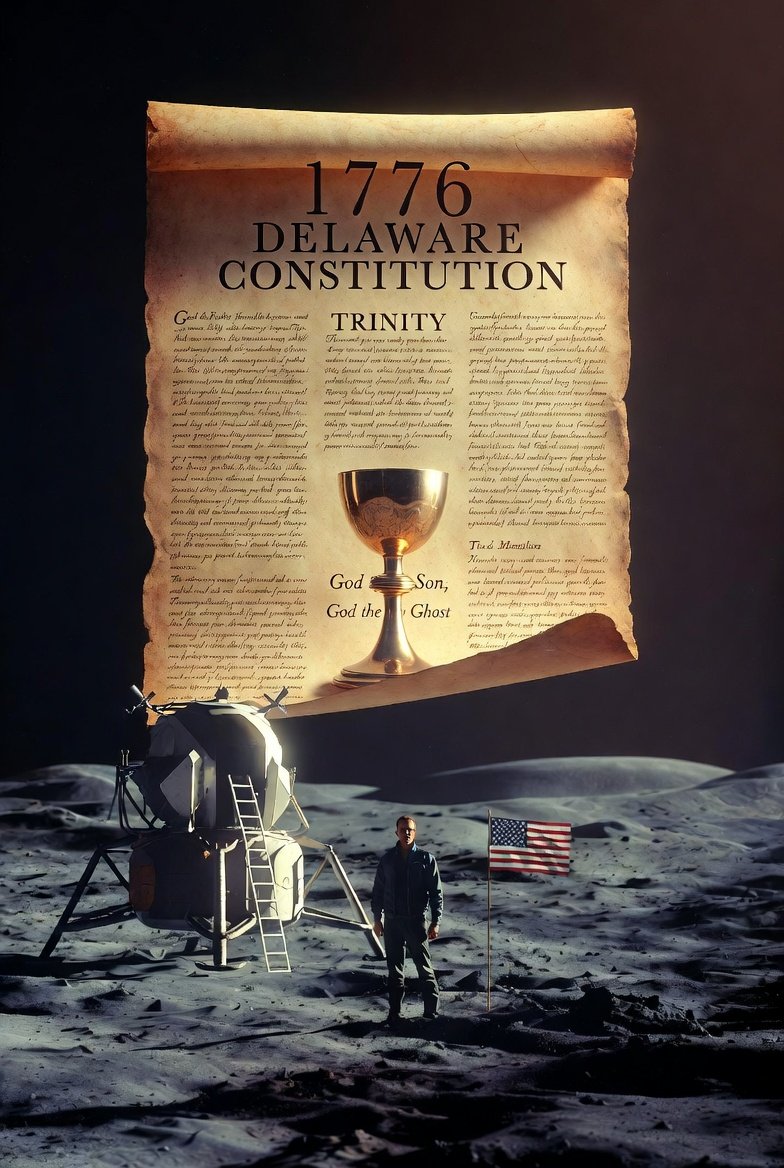
Nate examines original state constitutions proving America's explicitly Christian founding heritage and requirements
Was America Founded as a Christian Nation? State Constitutions from 1776 Prove It
What happens when Sunday morning begins with transman hospital selfies on X? Or when churches dance to Lady Gaga while remembering Buzz Aldrin taking communion on the moon? Nate examines whether America was founded as a Christian nation. He analyzes state constitutions from 1776—nine of fourteen states required officeholders to profess Christian faith. Delaware even demanded Trinitarian belief. This episode explores NASA’s suppression of religious expression in space. It also covers Madalyn Murray O’Hair’s lawsuit legacy. Finally, it explains why “separation of church and state” arguments misunderstand state sovereignty. Here is what unfolded.
Was America Founded as a Christian Nation? The Historical Evidence
The historical record remains unambiguous. Although the federal Constitution prohibited religious tests for office, original states maintained explicitly Christian requirements. Nine of thirteen states mandated religious tests for officeholders in their constitutions during the 1776-1784 period. Most required Protestant or Christian belief, with many colonies having established churches as official government-supported institutions.
Delaware’s 1776 Constitution demanded the strictest oath: “I do profess faith in God the Father, and in Jesus Christ His only Son, and in the Holy Ghost, one God, blessed for evermore; and I do acknowledge the holy scriptures of the Old and New Testament to be given by divine inspiration.” This Trinitarian formula excluded Unitarians, deists, and Scripture deniers. Maryland similarly required public officeholders to be Christians, though its restrictions evolved over time. Pennsylvania, New Jersey, North Carolina, Georgia, Vermont, Massachusetts, and New Hampshire all upheld similar Christian requirements.
The argument that America’s founders were mostly deists collapses under scrutiny. Early state constitutions reveal a nation whose individual states grounded governance in Christian principles. Meanwhile, the federal government remained neutral on religious establishment. For more exploration of faith’s cultural and political impact, check our Politics & Faith category or read “Are We a Christian Nation?” from Westminster Media.
Buzz Aldrin’s Secret Communion: NASA’s Religious Suppression
Before Neil Armstrong’s famous moonwalk, Buzz Aldrin accomplished something NASA tried to conceal: he took communion. The astronaut served as an elder at Webster Presbyterian Church. Before his 1969 space mission, he obtained special permission to bring bread and wine for communion. After the lunar module landed, Aldrin performed the first Christian sacrament on the moon.
Why the secrecy? Atheist activist Madalyn Murray O’Hair had sued NASA after Apollo 8 astronauts read Genesis during their Christmas 1968 broadcast from lunar orbit. Her lawsuit, formally filed as O’Hair v. Paine, argued that the reading violated the Establishment Clause since NASA is a government agency and astronauts are government employees. The court eventually dismissed the case, reasoning that plaintiffs showed no coercion or violation of their religious rights since the reading represented individual rather than government-mandated action.
Consequently, NASA officials feared litigation and asked Aldrin to keep his religious observance private. As detailed in this History.com article, the first liquid poured and first food eaten on the moon were communion elements. Public accounts omitted this fact for decades. Nate argues this cover-up marked a turning point, prioritizing secular sensibilities over the religious convictions that shaped America’s founding.

Defend America’s Christian heritage with biblical clarity—Nate’s book equips you for every conversation.
Watch the Full Episode
Watch on YouTube or see the full viral clip on America as a Christian nation
Connect With Us
Sources and Further Reading: Religious Tests and Oaths in State Constitutions, 1776-1784 | Legal Information Institute | Facing History and Ourselves | constitutingamerica.org
Share this post on:
 Share on Gab
.svg) Share on Truth Social
Share on Truth Social